One platform that has increasingly attracted scammers is Telegram. With its large user base, privacy-focused features, and minimal moderation in some areas, the platform has become a popular tool for cybercriminals.
Telegram scams range from fake investment groups to cryptocurrency fraud schemes and impersonation attacks. According to a 2025 financial crime report by fintech company Revolut, around 20% of reported scams now originate on Telegram, with fraud cases linked to the platform increasing by more than 233% in a single year. Many victims lose money, personal data, or access to their accounts because these scams can appear convincing and legitimate. Understanding how Telegram scams work, why scammers prefer the platform, and how to recognize suspicious behavior can help users protect themselves and avoid becoming victims.
What Are Telegram Scams?
Telegram scams are fraudulent schemes conducted through the Telegram app in which criminals attempt to deceive users into sending money, sharing personal information, and participating in fake investments.
Scammers often operate through private messages, fake groups, and impersonated accounts. They frequently pretend to be customer support representatives, cryptocurrency experts, and business professionals to gain trust. These scams can involve financial fraud, phishing attempts, and social engineering tactics designed to manipulate victims into taking actions that benefit the scammer.
Key Statistics About Messaging App Scams
- According to the Federal Trade Commission, consumers reported over $10 billion in fraud losses in 2025, with investment scams accounting for the largest share.
- Cryptocurrency scams alone caused over $3.9 billion in losses globally in 2025, according to blockchain analytics firm Chainalysis.
- Messaging platforms such as Telegram and WhatsApp, as well as social media apps, are increasingly used in social engineering scams and investment fraud schemes.
Why Do Scammers Use Telegram?
Scammers often prefer Telegram because of the platform’s features that allow them to communicate anonymously and manage large groups of potential victims.
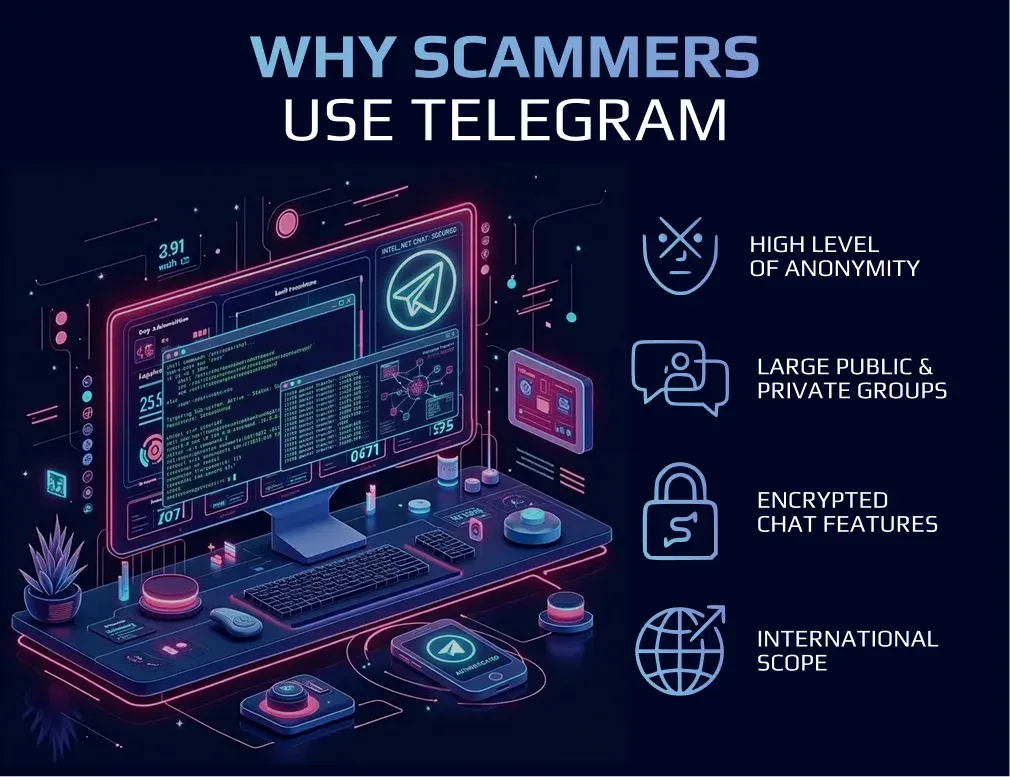
1. High Level of Anonymity
Telegram enables users to establish accounts with minimal identity verification. Scammers can easily create multiple accounts and usernames without revealing their real identity. This anonymity makes it difficult for victims and authorities to trace fraudulent accounts.
2. Large Public and Private Groups
Telegram supports groups with thousands of members and channels that can broadcast messages to unlimited subscribers. Fraudsters use these groups to promote fake investments, pump-and-dump crypto schemes, and phishing campaigns. Large groups create an illusion of legitimacy, making victims believe the opportunity is popular and trustworthy.
3. Encrypted Messaging Features
Telegram offers secure messaging options, including secret chats with end-to-end encryption. While encryption protects legitimate users’ privacy, scammers sometimes use it to hide fraudulent activity.
4. Easy International Scope
Telegram has a worldwide presence, enabling scammers to target victims across countries without geographic limitations effectively. This makes it a significant platform for fraudulent activity.
Common Telegram App Scams
Telegram scammers use various tactics to trick users into sending money and sharing sensitive information.
Fake Investment Groups
One of the most common Telegram scams involves fake investment communities. Scammers create channels that promise extremely high returns from trading, cryptocurrency investments, and forex trading.
They often post screenshots of fake profits or testimonials from fake users to convince others to join. After victims send money to participate in the investment program, the scammers disappear or demand additional payments to withdraw profits.
Impersonation Scams
In impersonation scams, criminals impersonate well-known companies, influencers, and customer support agents. For instance, scammers pose as support representatives for cryptocurrency exchanges or trading platforms and ask victims to share login credentials and transfer funds for “account verification.”
Phishing Links
Many Telegram scams include links that lead to fake websites designed to steal login details, credit card information, and crypto wallet credentials. Once victims enter their information, scammers can access their accounts and steal funds.
Giveaway and Promotion Scams
Some Telegram channels advertise fake giveaways, claiming users can receive free cryptocurrency or prizes. To claim the reward, victims are asked to send a small payment, verify their wallet, and share personal details. In reality, no giveaway exists.
Telegram Money Scams
Money scams on Telegram usually involve convincing users to send funds directly to the scammer. These scams often promise quick profits, financial assistance, and exclusive investment opportunities. Once the victim sends money, the scammer either disappears or continues asking for additional payments.
Common Telegram money scams include:
- Fake loan offers
- Pyramid schemes
- Online job scams that require upfront fees
- Fraudulent trading signals or investment subscriptions
Telegram Crypto Scams
Cryptocurrency scams are particularly common on Telegram, which hosts many crypto communities and trading groups. Scammers exploit the popularity of digital assets such as Bitcoin and Ethereum to create convincing fraud schemes.
Fake Crypto Investment Platforms
Fraudsters create fake crypto trading platforms and invite users through Telegram groups. Victims see fake dashboards showing large profits, encouraging them to invest more money. However, when they try to withdraw funds, the scammers demand additional fees and block the account entirely.
Pump-and-Dump Schemes
In pump-and-dump scams, scammers organize Telegram groups to coordinate buying low-value cryptocurrencies to inflate their prices artificially. Once prices rise, scammers sell their holdings for profit, while ordinary investors are left with worthless tokens.
Fake Crypto Airdrops
Some scammers advertise free cryptocurrency airdrops and ask users to connect their wallets and send a small transaction to “verify” eligibility. This process allows scammers to steal funds and gain access to the victim’s wallet.
How Telegram Scammers Trick People?
Scammers on Telegram often rely on social engineering techniques rather than technical hacking. Their goal is to manipulate victims into trusting them and voluntarily sending money, sharing sensitive information, and joining fraudulent schemes. Below are some of the most common methods they use.
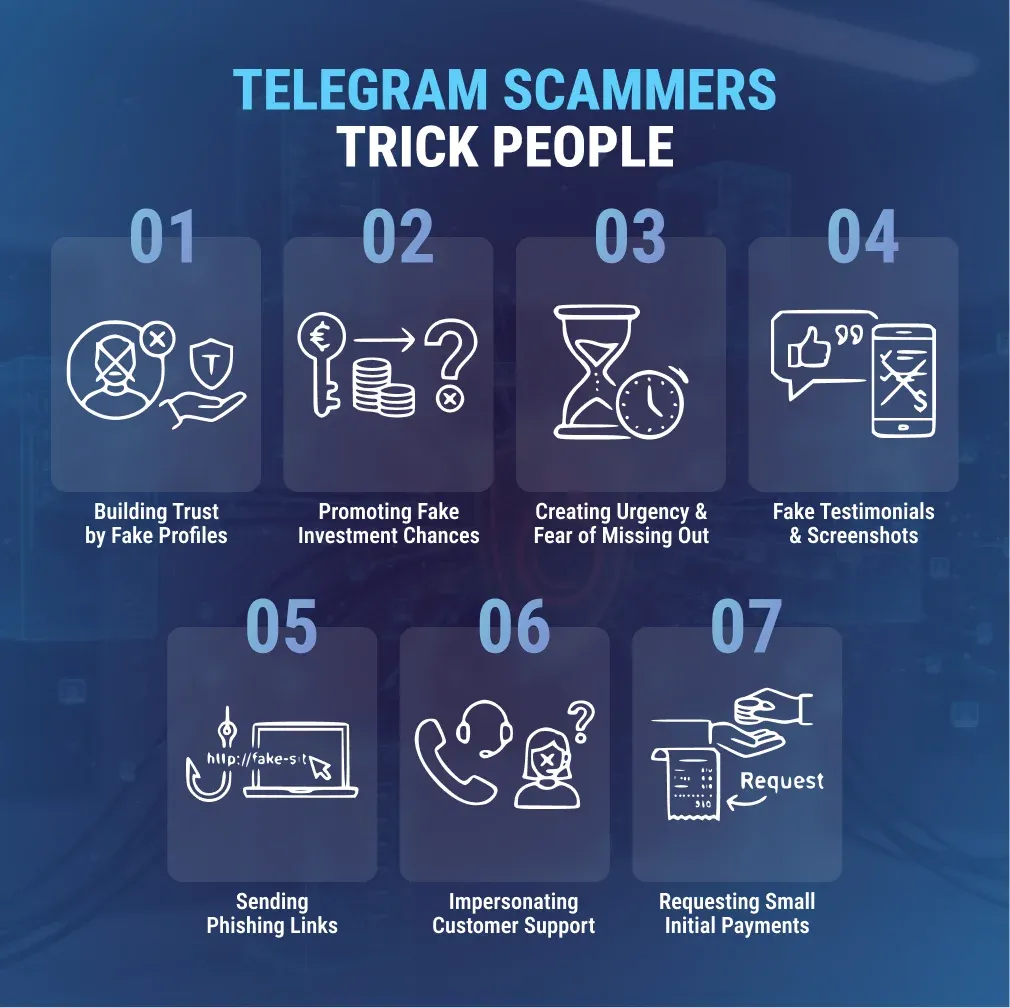
1. Building Trust Through Fake Profiles
Many Telegram scammers create profiles that appear professional and trustworthy. They may pretend to be financial experts, customer support agents, and representatives of well-known companies. These fake accounts often use stolen profile photos, copied biographies, and professional-looking usernames. By appearing credible, scammers can easily gain the trust of unsuspecting users.
2. Promoting Fake Investment Opportunities
One of the most common tactics involves promoting fake cryptocurrency and trading opportunities. Scammers may invite users to Telegram groups that claim to provide expert trading signals and guaranteed profits.
They often mention popular cryptocurrencies such as Bitcoin or Ethereum to make the opportunity seem legitimate. Victims are encouraged to invest money quickly before the opportunity expires.
3. Creating Urgency and Fear of Missing Out
Scammers frequently pressure users into making quick decisions by creating a sense of urgency. They may claim that an investment offer is limited or that only a few spots are available. This tactic triggers fear of missing out (FOMO), pushing victims to send money without properly verifying the offer.
4. Using Fake Testimonials and Screenshots
To make scams appear legitimate, fraudsters often share screenshots showing large profits and testimonials from supposed satisfied users. These testimonials are usually fake accounts controlled by the scammers themselves. Seeing multiple people claiming success can make victims believe the scheme is genuine.
5. Sending Phishing Links
Some Telegram scams involve sending phishing links to fake websites that appear to be legitimate services. These pages are designed to collect login credentials, banking details, and cryptocurrency wallet information. Once victims enter their information, scammers can access their accounts and steal funds.
6. Impersonating Customer Support
Another common trick is impersonating the support teams of well-known platforms. Scammers may contact users pretending to be representatives of crypto exchanges and financial services. They claim there is an issue with the user’s account and ask for passwords, verification codes, or payments to “resolve” the problem.
7. Requesting Small Initial Payments
Some scammers begin by asking for a small amount of money to build trust. After victims send the first payment, scammers often request additional funds for processing fees, taxes, and withdrawal charges. Eventually, the victim realizes that the promised returns never exist.
How to Identify a Telegram Scammer?
Identifying scammers on Telegram can be challenging because many fraudsters create convincing profiles and professional-looking messages. However, several warning signs can help you recognize a Telegram scammer before becoming a victim.
1. Unrealistic Promises of High Profits
One of the biggest red flags is when someone promises guaranteed and extremely high profits, especially in investment or trading opportunities. Scammers frequently claim they can generate quick returns through cryptocurrency trading involving assets like Bitcoin or Ethereum. Legitimate investments always involve risk, so anyone promising risk-free profits and guaranteed returns is likely running a scam.
2. Requests for Upfront Payments
A common tactic used by Telegram scammers is asking for an upfront payment. Once the victim sends money, the scammer usually disappears or continues asking for more payments. They may claim the payment is required for:
- Investment entry fees
- Account verification
- Withdrawal processing
- Taxes or service charges
3. Suspicious and Newly Created Profiles
Scam accounts often have very little activity or incomplete profile details. These profiles are typically created quickly so scammers can abandon them once victims start reporting them. Warning signs include:
- Recently created accounts
- No profile picture or stolen images
- Generic usernames or random numbers
- Very few contacts or interactions
4. Unsolicited Messages From Strangers
If someone you don’t know suddenly contacts you on Telegram with an investment opportunity, job offer, or giveaway, it should raise suspicion. Scammers often send unsolicited messages to thousands of users, hoping that some people will respond and engage with their offers.
5. Pressure to Act Quickly
Fraudsters frequently create a sense of urgency to prevent victims from thinking carefully. They say the opportunity is limited, exclusive, and expiring soon. This pressure tactic is designed to make users send money and share information before verifying the offer.
6. Requests for Sensitive Information
Legitimate companies and customer support teams will never ask for this type of information through Telegram messages. A major warning sign is when someone asks for sensitive details such as:
- Passwords
- One-time verification codes
- Banking details
- Cryptocurrency wallet private keys
7. Suspicious Links and External Websites
Many Telegram scams include links to websites that look professional but are actually fake. These sites are designed to steal login credentials and financial information. Before clicking any link, check whether the website belongs to a legitimate company and verify its authenticity.
8. Fake Testimonials and Group Activity
Some scammers create Telegram groups filled with fake accounts that post positive reviews and screenshots of profits. These messages are meant to create social proof and make the scheme appear trustworthy. If a group is filled with overly enthusiastic success stories but lacks verifiable information, it may be a coordinated scam.
Tips to Stay Safe From Telegram Scams
As scams continue to rise on messaging platforms like Telegram, users need to take proactive steps to protect their accounts and personal information. While Telegram offers useful privacy features, staying cautious and following basic online safety practices can significantly reduce the risk of falling for scams.
1. Avoid Sending Money to Strangers
One of the most effective ways to prevent financial loss is to never send money to people you don’t know and trust. Many Telegram scams involve strangers offering investment opportunities, trading signals, or job offers that require upfront payments. If someone asks you to transfer money for an opportunity that sounds too good to be true, it is likely a scam.
2. Verify Accounts Before Trusting Them
Scammers often impersonate companies, influencers, or support teams. Before trusting any account, verify its authenticity by checking official websites and contacting the company directly through verified channels. Legitimate organizations rarely use Telegram as their primary customer support platform.
3. Be Careful With Cryptocurrency Offers
Many Telegram scams involve cryptocurrency investments and giveaways related to assets like Bitcoin and Ethereum. Fraudsters frequently promise guaranteed profits and exclusive trading opportunities. Always research investment platforms and avoid sending cryptocurrency to unknown wallets, as these transactions are usually irreversible.
4. Do Not Click Suspicious Links
Scammers often send phishing links that lead to fake login pages and malicious websites. Clicking these links can expose your personal information and infect your device with malware. Before opening any link, check the URL carefully and confirm that it belongs to a legitimate website.
5. Protect Your Account With Security Settings
Enabling additional security features on Telegram can help protect your account from unauthorized access. These measures make it harder for scammers to hijack and impersonate your account. Important settings include:
- Two-step verification
- Login alerts for new devices
- Privacy controls for phone numbers and profile information
6. Avoid Joining Suspicious Telegram Groups
Many scams originate in large Telegram groups that promote trading signals, investment programs, and giveaways. These groups often contain fake testimonials and manipulated screenshots showing profits. If a group focuses heavily on making money quickly and asks members to invest funds, it should be treated with caution.
7. Never Share Sensitive Information
Your passwords, verification codes, banking details, and cryptocurrency wallet keys should never be shared with anyone on Telegram. Legitimate services will never request such information through private messages. Keeping this information private is essential to preventing identity theft and financial fraud.
8. Report and Block Suspicious Accounts
If you encounter suspicious messages or accounts, report them immediately through Telegram’s reporting system and block the user. Reporting scams helps prevent others from becoming victims and allows the platform to take action against fraudulent accounts.
Conclusion
Telegram scams have become increasingly common as cybercriminals exploit messaging platforms to target unsuspecting users. From fake investment groups to cryptocurrency fraud and impersonation attacks, scammers use sophisticated tactics to trick people into sending money or revealing sensitive information.
By understanding how these scams work and recognizing warning signs, users can protect themselves and avoid financial losses. Staying cautious, verifying information, and avoiding unrealistic investment offers are essential steps in staying safe on Telegram.
FAQs
Here are some of the frequently asked questions.
How do Telegram scammers trick people?
Telegram scammers typically use social engineering techniques such as fake investment opportunities, impersonation, and phishing links. They often build trust with victims before asking for money or personal information.
Why do scammers prefer using Telegram?
Scammers prefer Telegram because it offers anonymity, large-group messaging, and global reach. These features make it easier for fraudsters to contact many potential victims while hiding their identity.
How can you identify a Telegram scammer?
You can identify a Telegram scammer by looking for warning signs such as requests for upfront payments, unrealistic profit promises, or pressure to act quickly.
Table of Contents