Another 2025 report found that social engineering attacks accounted for 36% of all cyber intrusions, making it one of the most common attack methods used by cybercriminals today. In this blog, we will explore social engineering attacks, their examples, and ways to prevent them.
What Is a Social Engineering Attack?
A social engineering attack is a type of cyberattack in which criminals manipulate people into revealing confidential information, granting unauthorized access, and performing actions that compromise security. Instead of targeting software vulnerabilities directly, attackers exploit human emotions such as fear, trust, urgency, and greed.
These attacks can occur via email, phone, text, social media, fake websites, and face-to-face interactions. The primary goal is usually to steal passwords, financial information, company data, and personal details.
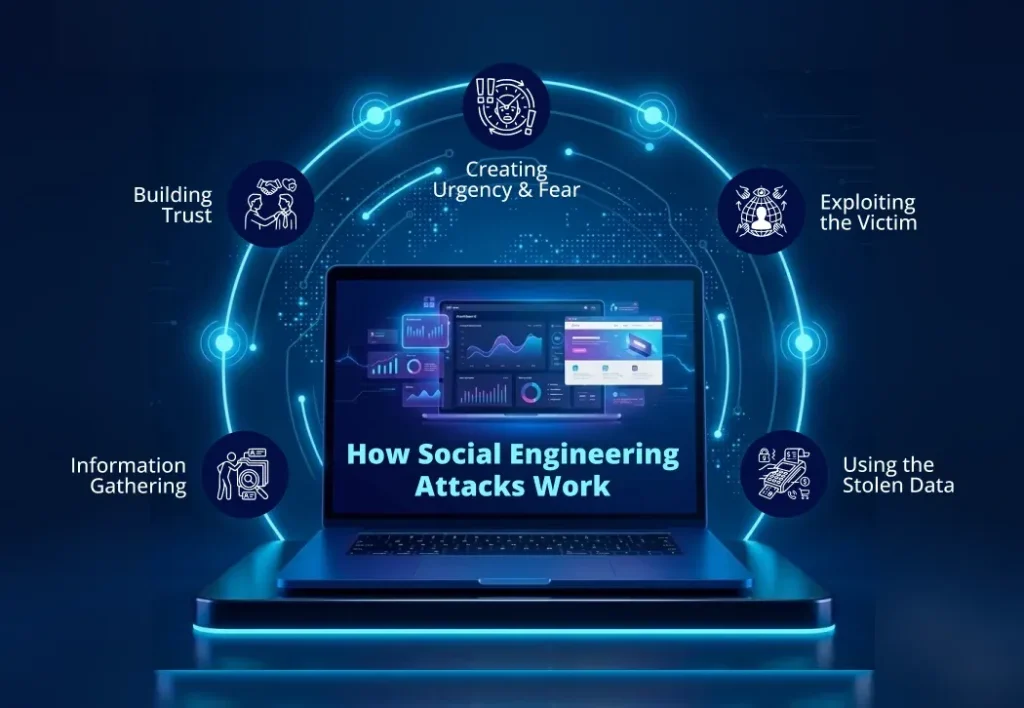
How Social Engineering Attacks Work?
These attacks usually work in the following process.
1. Information Gathering
Attackers first collect information about the victim from social media, company websites, leaked databases, and public records.
2. Building Trust
The attacker pretends to be someone trustworthy, such as a bank representative, coworker, technical support agent, and government official.
3. Creating Urgency and Fear
Victims are pressured into acting quickly through fake warnings, emergencies, and attractive offers.
4. Exploiting the Victim
The attacker convinces the victim to share sensitive information, transfer money, click on malicious links, and download infected files.
5. Using the Stolen Data
Once attackers gain access, they may steal money, install malware, commit identity theft, and launch larger cyberattacks.
Social Engineering Attack Techniques
The following are the social engineering attack techniques.
Phishing
Phishing is one of the most widely used social engineering attack techniques. In a phishing attack, cybercriminals send fraudulent emails, messages, and website links that appear to come from trusted organizations such as banks, online services, and government agencies. The goal is to trick victims into revealing sensitive information, such as passwords, credit card details, and login credentials. These attacks often create a sense of urgency, pressuring users to act quickly without verifying the source.
Spear Phishing
Spear phishing is a more targeted form of phishing that targets specific individuals and organizations. Attackers research their targets and personalize messages using real names, job titles, and company information to make the communication appear legitimate. These messages are customized and highly convincing; victims are more likely to trust them, share confidential data, and click on malicious links.
Vishing
Vishing, short for voice phishing, involves scammers using phone calls to deceive victims. Attackers impersonate bank representatives, technical support agents, government officials, and customer service personnel to gain trust. During the call, they attempt to collect sensitive information such as banking credentials, one-time passwords, and personal identification details. Vishing attacks often rely on fear and urgency to manipulate victims into cooperating.
Smishing
Smishing is a social engineering technique carried out through SMS and text messages. Attackers send fake delivery notifications, account alerts, prize announcements, and urgent security warnings containing malicious links. These messages encourage users to click links and provide personal information. Since people tend to trust text messages more than emails, smishing attacks can be highly effective.
Pretexting
Pretexting involves attackers creating a fabricated scenario and a false identity to manipulate victims into sharing confidential information. The attacker may pretend to be a coworker, HR representative, police officer, or IT technician to gain the victim’s trust. Unlike phishing, pretexting usually involves longer conversations and carefully planned deception to extract sensitive information over time.
Baiting
Baiting attacks exploit curiosity and greed by offering something attractive in exchange for interaction. Attackers may distribute infected USB drives, fake software downloads, free movie links, and promotional offers that contain malware. Once the victim interacts with the bait, malicious software may be installed on their device, allowing attackers to steal data and gain unauthorized access.
Tailgating
Tailgating is a physical social engineering attack where an unauthorized person gains access to a restricted area by following an authorized individual. Attackers may impersonate employees, delivery workers, and maintenance staff to bypass security controls. This technique relies on human politeness and trust, as employees may hold doors open for someone without verifying their identity.
Quid Pro Quo Attacks
In quid pro quo attacks, cybercriminals offer a service and benefit in exchange for sensitive information and system access. For example, an attacker may impersonate IT support and offer technical assistance while asking the victim to turn off security settings and reveal login credentials. Victims are manipulated into cooperating because they believe they are receiving legitimate help and rewards.
Scareware
Scareware attacks use fear tactics to trick victims into taking certain actions. Attackers display fake virus warnings, security alerts, and pop-up messages claiming that the victim’s device is infected. The victim is then encouraged to download fake antivirus software and pay for unnecessary services. In reality, the software contains malware and leads to financial scams.
Watering Hole Attacks
In a watering hole attack, cybercriminals compromise websites frequently visited by a specific group of users and by an organization’s employees. When victims visit the infected website, malware is automatically downloaded onto their devices. This technique is highly targeted and often used against businesses, government agencies, and high-profile organizations.
Impersonation Attacks
Impersonation attacks occur when criminals impersonate trusted individuals, such as executives, coworkers, vendors, and customer support agents. Attackers use fake identities to manipulate victims into transferring money, revealing sensitive information, and granting system access. These attacks are especially common in business email compromise (BEC) scams.
Examples of a Social Engineering Attack
Here are some examples of a social engineering attack.
Fake Bank Email Scam
One of the most common examples of a social engineering attack is a fake bank email scam. In this attack, cybercriminals send emails that appear to come from a legitimate bank or financial institution. The message claims there is suspicious activity on the victim’s account and asks them to click a link to verify their information. The link usually leads to a fake website designed to steal login credentials, credit card details, and banking information.
Tech Support Scam
In a tech support scam, attackers impersonate representatives of well-known technology companies. Victims may receive phone calls, pop-up warnings, and emails claiming their devices are infected with malware and are experiencing technical issues. The scammer then convinces the victim to install remote access software and pay for fake support services. Once access is granted, attackers can steal data, install malware, and demand additional payments.
CEO Fraud Attack
CEO fraud, also known as business email compromise (BEC), targets employees within organizations. Attackers impersonate executives and send urgent requests for wire transfers, gift card purchases, and confidential information. Because the request appears to come from a trusted authority figure, employees comply without verifying its authenticity, resulting in financial losses for the company.
Fake Delivery Notification
Attackers often send fraudulent delivery notifications through text messages and emails. These messages claim there is a problem with a package delivery and ask the recipient to click a link to reschedule and pay a small fee. The link usually leads to a phishing website and installs malware on the victim’s device. This type of attack is effective because many people regularly shop online and expect delivery updates.
Social Media Impersonation
In social media impersonation attacks, cybercriminals create fake profiles that imitate real individuals, companies, and customer support accounts. Attackers use these fake accounts to build trust with victims and persuade them to share personal information, send money, and click on malicious links. These scams are especially common on platforms where users interact frequently with brands and influencers.
Fake Job Offer Scam
Job seekers are often targeted through fake job offers and recruitment scams. Attackers post fake job listings and contact victims pretending to be recruiters from legitimate companies. During the hiring process, victims may be asked to provide personal information, banking details, and upfront payments for training and equipment. The primary goal is usually identity theft and financial fraud.
USB Baiting Attack
In a USB baiting attack, cybercriminals leave infected USB drives in public places such as offices, parking lots, and coffee shops. Curious individuals may plug the device into their computers to identify the owner and view the contents. Once connected, malware is automatically installed, giving attackers access to the system and network.
Scareware Pop-Up Scam
Scareware attacks use fake security alerts to frighten users into taking immediate action. Victims see pop-up messages claiming their device is infected with viruses and that their data is at risk. The alert urges users to download fake antivirus software and contact fraudulent support services. Instead of fixing the problem, the software may install malware and steal financial information.
Pretexting Through Phone Calls
In pretexting attacks, scammers create believable stories to gain confidential information. For example, an attacker may call an employee pretending to be from the company’s IT department and request login credentials to “fix a system issue.” Because the attacker sounds professional and convincing, the victim unknowingly shares sensitive information.
Tailgating Into Secure Buildings
Tailgating is a physical social engineering attack where an unauthorized person gains access to a restricted area by following an authorized employee through a secure entrance. Attackers pretend to be delivery workers, maintenance staff, and visitors to avoid suspicion. Once inside, they steal devices, access confidential documents, and compromise internal systems.
Signs of a Social Engineering Attack
The following are some signs of a social engineering attack.
Unexpected Requests and Sensitive Information
One of the clearest signs of a social engineering attack is receiving an unexpected request for sensitive data such as passwords, OTP codes, banking details, and personal identification information. Legitimate organizations rarely ask for confidential information via email, text, or phone. If a request feels unusual and unprompted, it should be treated with caution.
Sense of Urgency and Pressure
Social engineering attacks often create a false sense of urgency to push victims into acting quickly without thinking. Messages may claim that your account will be locked, a payment is overdue, and immediate action is required to avoid penalties. This pressure tactic is designed to reduce your ability to properly verify the request.
Suspicious Links and Attachments
Emails and messages containing unknown links or unexpected attachments are a major red flag. These links lead to fake websites designed to steal login credentials, while attachments may contain malware. Even if the message looks legitimate, hovering over links and checking the sender’s details can reveal inconsistencies.
Impersonation of Trusted Sources
Attackers often impersonate trusted individuals and organizations, such as banks, government agencies, delivery companies, and even coworkers and managers. If the tone, email address, and communication method seem slightly off compared to official channels, it indicates impersonation.
Grammar and Formatting Issues
Many social engineering attacks contain spelling mistakes, awkward phrasing, and unprofessional formatting. While not always present, these errors can indicate that the message is fraudulent, especially if it claims to be from a reputable company.
Requests to Bypass Security Procedures
A strong warning sign is when someone asks you to ignore and bypass normal security steps, such as sharing passwords, turning off multi-factor authentication, and transferring money without approval. Legitimate organizations follow strict security protocols and will not ask you to break them.
Too-Good-To-Be-True Offers
Messages offering unexpected rewards, such as lottery winnings, gifts, or exclusive deals, can also indicate a social engineering attempt. These offers are designed to attract attention and encourage users to click on malicious links and share personal information.
Unusual Sender Information
Always check the sender’s email address and phone number carefully. Attackers often use addresses that closely resemble legitimate ones but include small changes, such as extra characters and misspellings. These subtle differences are a common indicator of fraud.
Emotional Manipulation Tactics
Social engineering attacks often rely on emotional triggers such as fear, curiosity, excitement, and sympathy. If a message feels emotionally charged and tries to push you into reacting immediately, it may be designed to manipulate your judgment.
Unsolicited Contact from “Support Teams”
Receiving unexpected calls, emails, and messages from so-called support teams claiming to fix an issue you did not report is another sign of an attack. These scammers often try to gain remote access to your device and request login credentials under the guise of assistance.
Social Engineering Attack Prevention
The following steps can help prevent a social engineering attack.
Verify Requests Before Taking Action
One of the most effective ways to prevent social engineering attacks is always to verify any request for sensitive information. If you receive an email, call, or message requesting passwords, financial details, or system access, confirm it through official channels. Contact the organization directly via their verified website and phone number, rather than replying to the suspicious message.
Use Multi-Factor Authentication (MFA)
Multi-factor authentication adds an extra layer of security beyond just a password. Even if attackers steal login credentials through social engineering, MFA can prevent unauthorized access by requiring a second verification step, such as a code sent to your phone via an authentication app.
Be Cautious with Links and Attachments
Avoid clicking on links and downloading attachments from unknown and unexpected sources. These are commonly used to deliver phishing pages and malware. Always hover over links to check the actual URL and ensure it matches the legitimate website before clicking.
Strengthen Password Practices
Using strong, unique passwords for each account significantly reduces the risk of compromise. Avoid reusing passwords across platforms, and consider using a password manager to store and generate complex passwords securely.
Limit Personal Information Sharing
Cybercriminals often gather information from social media and public platforms to make their attacks more convincing. Limiting the amount of personal, professional, and organizational information you share online makes it harder for attackers to craft targeted scams.
Educate Employees and Users
Regular cybersecurity awareness training helps individuals recognize common social engineering tactics such as phishing, impersonation, and pretexting. Organizations that train their staff are significantly less likely to fall victim to these attacks.
Keep Software and Systems Updated
Updating operating systems, browsers, and applications ensures that security vulnerabilities are patched. While social engineering focuses on human manipulation, attackers often combine it with malware that exploits outdated software.
Use Security Tools and Filters
Antivirus software, email spam filters, and firewalls can help detect and block malicious content before it reaches users. These tools add an important layer of defense against phishing emails and harmful attachments.
Be Skeptical of Urgent and Emotional Messages
Social engineering attacks often rely on urgency, fear, and excitement to manipulate victims. Taking a moment to pause and think before responding can prevent costly mistakes. If a message pressures you to act immediately, it is important to double-check its authenticity.
Report Suspicious Activity
If you suspect a social engineering attempt, report it to your IT department, email provider, and the relevant organization. Early reporting can help prevent others from becoming victims and allow security teams to respond quickly.
Why Social Engineering Attacks Are Dangerous?
Social engineering attacks are dangerous because they target human behavior rather than technical systems. Even organizations with advanced cybersecurity protections can become vulnerable if employees and users are manipulated into revealing information and granting access.
These attacks can result in:
- Financial losses
- Identity theft
- Data breaches
- Malware infections
- Business disruption
- Reputation damage
Conclusion
Social engineering attacks continue to evolve as cybercriminals become more sophisticated in manipulating human behavior. From phishing emails and fake phone calls to impersonation scams and malicious text messages, these attacks rely on deception rather than technical hacking skills. Because human error remains one of the biggest cybersecurity risks, awareness and prevention are essential. By verifying suspicious requests, implementing strong security measures, and staying informed about common attack techniques, individuals and organizations can significantly reduce the risk of becoming victims of social engineering.
FAQs
Here are some of the most frequently asked questions.
What is a common method used in social engineering?
Phishing is one of the most common social engineering methods. Attackers use fake emails, messages, and websites to trick victims into revealing sensitive information.
What best describes a social engineering attack?
A social engineering attack is a cyberattack that manipulates people into revealing confidential information and performing actions that compromise security.
Can social engineering attacks happen over the phone?
Yes, social engineering attacks can occur over the phone. These attacks are called vishing, in which scammers impersonate trusted individuals and organizations.
Are social engineering attacks preventable?
Yes, social engineering attacks are largely preventable through cybersecurity awareness, employee training, strong authentication methods, and careful verification of suspicious communications.
Table of Contents