Most attacks also rely on human factors and weaknesses in physical security. One of the dumbest and easiest attack methods is the so-called ‘tailgating,’ a social engineering trick in which an unauthorized person gains access to a security-restricted building by following a legitimate person. Despite widespread concern, only 15% of organizations actively track tailgating incidents, creating a significant visibility gap in physical security programs.
Organizations spend large amounts of money on firewalls, antivirus programs, and network security measures; however, physical security weaknesses can reveal confidential information, technical systems, and valuable assets. A 2026 physical security report found that 88% of businesses experienced the same or more physical security incidents in 2025, underscoring the persistence of physical threats, including unauthorized entry attempts. Understanding what tailgating is, how it works, and how to prevent it is essential for maintaining a strong security posture. In this article, we will cover tailgating attacks in cybersecurity and provide you with some examples, risks and methods of prevention.
What Is a Tailgating Attack?
A tailgating attack is a physical security breach in which an unauthorized person gains access to a restricted area by closely following an authorized individual through a secured entrance. Rather than bypassing security systems through technical means, attackers exploit human courtesy, trust, and distraction.
The attacker may impersonate an employee, visitor, delivery worker, or contractor to gain access without proper authentication. Tailgating is considered a form of social engineering because it manipulates people rather than technology. Once inside a secure area, attackers may steal data, install malicious devices, access confidential information, or conduct further cyberattacks.
What Is Tailgating in Cyber Security?
In cybersecurity, tailgating refers to the unauthorized physical entry into secure locations housing sensitive systems, data, and infrastructure.
Examples include:
- Data centers
- Server rooms
- Corporate offices
- Research facilities
- Government buildings
- Healthcare institutions
Because physical access often leads to digital access, tailgating is considered a significant cybersecurity threat. An attacker who enters a secure facility may connect rogue devices to the network, steal credentials, and gain access to confidential information.
What Is Tailgating Social Engineering?
Tailgating is a social engineering attack because it relies on human psychology rather than technical vulnerabilities.
Attackers often exploit:
- Politeness
- Trust
- Sympathy
- Authority
- Urgency
- Distraction
For instance, an attacker carrying heavy boxes may approach a secure door and wait for an employee to hold it open. The employee, trying to be helpful, unknowingly grants unauthorized access. This manipulation of normal human behavior makes tailgating highly effective.
Are Tailgating Attacks Still Common Today?
Tailgating remains among the top physical security threats because it hinges on human nature rather than technology. While many corporations have strengthened their digital security, malicious individuals can still exploit social engineering tactics to circumvent technical controls.
Open offices, hybrid work models, and large office buildings are examples of environments where an attacker could easily blend in and gain unauthorized access. As long as people choose convenience over security, tailgating will be one of the most serious security issues.
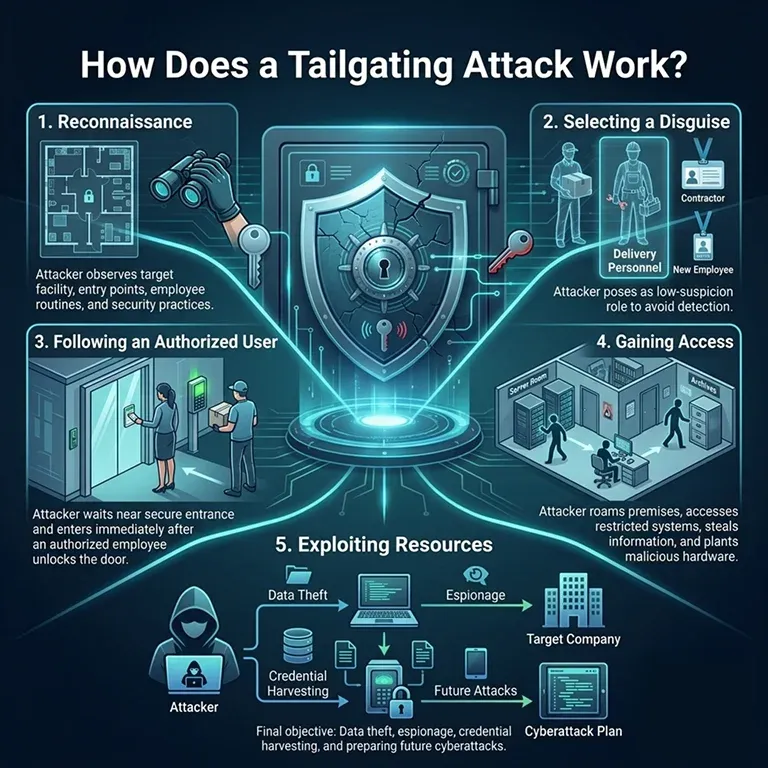
How Does a Tailgating Attack Work?
A tailgating attack typically follows several stages.
Reconnaissance
The attacker observes the target facility and identifies entry points, employee routines, and security practices.
Selecting a Disguise
To avoid suspicion, the attacker may pose as:
- Delivery personnel
- Maintenance workers
- Contractors
- Visitors
- New employees
Following an Authorized User
The attacker waits near a secure entrance and enters immediately after an authorized employee unlocks the door.
Gaining Access
Once inside, the attacker roams the premises, accesses restricted systems, steals information, and plants malicious hardware.
Exploiting Resources
The final objective involves data theft, espionage, credential harvesting, and preparing for future cyberattacks.
Tailgating Attack Examples
Tailgating attacks are better understood when we visualize them in real-life situations.
Following an Employee into an Office
In this case, the attacker lingers at the office building entrance until an employee arrives and, upon the employee using the access card to unlock the door, slips in behind them.
Delivery Person Impersonation
Here, the attacker poses as a delivery person with packages and uses a ploy to gain entry to a secure building.
Data Center Intrusion
By tailgating a legitimate service person, a cyberattacker can gain access to a data center and network equipment.
Hospital Access
By following the hospital staff through locked doors, a person with no right to enter can gain access to restricted medical areas.
Corporate Espionage
Through the stealthy entry of employees via the tailgate, competitors and other harmful individuals obtain access to confidential business information.
Why Are Tailgating Attacks Considered a Security Risk?
Tailgating attacks pose serious threats because they allow attackers to bypass physical security measures without triggering alarms.
Unauthorized Access: Tailgating allows attackers to enter restricted areas without proper authentication or credentials.
Data Theft: Intruders may gain access to sensitive documents, devices, or confidential business information.
Network Compromise: Attackers can connect rogue devices to the organization’s network, potentially leading to cyberattacks.
Physical Asset Theft: Unauthorized individuals may steal laptops, equipment, access cards, or other valuable assets.
Bypassing Security Controls: Tailgating defeats physical security measures such as key cards, biometric scanners, and secure entry systems.
Increased Insider Threat Risk: Once inside, attackers can blend in with employees and move around the facility with less suspicion.
Financial Losses: Security breaches resulting from tailgating can lead to legal costs, regulatory fines, and operational disruptions.
What Is the Difference Between Tailgating and Piggybacking?
Although the terms are often used interchangeably, there is a subtle difference.
Tailgating
In a tailgating attack, the authorized person is typically unaware that someone is following them into a restricted area.
Example: An employee enters a building while an unauthorized individual quietly follows behind.
Piggybacking
Piggybacking occurs when the authorized person knowingly allows someone to enter, often believing they are helping a legitimate visitor.
Example: An employee intentionally leaves a secure door open for someone who claims to have forgotten their access card.
The key distinction is awareness: tailgating involves unintentional access, while piggybacking involves intentional assistance.
Where Do Tailgating Attacks Commonly Occur?
Tailgating attacks can occur in any environment with controlled access.
Corporate Offices
Office buildings often rely on employee access cards and are common targets.
Data Centers
Attackers seek access to critical infrastructure and networking equipment.
Government Facilities
Sensitive government information makes these facilities attractive targets.
Healthcare Organizations
Hospitals and clinics store valuable medical records and personal data.
Educational Institutions
Universities frequently have large campuses with varying levels of security.
Manufacturing Facilities
Attackers may target intellectual property, trade secrets, and production systems.
How to Prevent Tailgating Security Attacks?
Companies can dramatically reduce the risk of tailgating by combining physical security measures with increased employee awareness.
Implement Strong Access Control Systems
Your organization should use robust access controls—such as key cards, biometrics, PIN codes, or mobile credentials—to secure entry points, ensuring that only authorized individuals can access restricted areas and making it harder for attackers to gain unauthorized access.
Conduct Employee Security Awareness Training
Your employees are often your best line of defense against tailgating attacks. Regular security awareness training helps staff recognize social engineering techniques and understand why they shouldn’t allow strange people into secure areas. Encourage staff to kindly challenge strangers and, if necessary, check their credentials.
Install Turnstiles and Mantraps
Physical security barriers, such as turnstiles or mantraps, can greatly mitigate tailgating risks. They’re designed to allow only one person through at a time after they’ve successfully authenticated themselves, so no one else can follow too closely.
Enforce Visitor Management Procedures
Everyone should be required to sign in, show ID, and wear visitor badges. Ideally, visitors should be escorted by an employee whenever they are entering restricted spaces. A solid visitor management policy can help prevent hackers from slipping through disguised as guests.
Deploy Surveillance Cameras
Place security cameras at entrances/exits and in sensitive areas. This will help you identify suspicious behavior and discourage possible attackers. Also, video footage provides valuable evidence during an investigation after someone has been caught tailgating.
Require Visible Identification Badges
Employees, contractors, and visitors should wear ID badges at all times while inside your facility. Visible credentials make it easy to spot an imposter and hold people accountable for their actions.
Employ Security Personnel
Trained security guards can monitor access points, verify identities, and challenge individuals attempting to enter restricted areas without authorization. Their presence serves as both a deterrent and an additional layer of security.
Create a Security-Conscious Workplace Culture
Organizations should foster a culture where security is everyone’s responsibility. Employees should feel comfortable reporting suspicious behavior and questioning individuals who do not display proper credentials. Encouraging vigilance helps reduce the likelihood of successful tailgating attempts.
Conduct Regular Security Audits
Periodic assessments of physical security measures can help identify vulnerabilities before attackers exploit them. Security audits should evaluate access control systems, employee compliance, visitor procedures, and surveillance coverage to ensure effective protection against tailgating.
Integrate Physical and Cybersecurity Strategies
Since tailgating can lead to both physical and digital security breaches, organizations should align their physical security policies with cybersecurity programs. A coordinated approach helps protect sensitive assets, systems, and information from unauthorized access.
Best Practices for Organizations to Prevent Tailgating
Organizations should employ a layered approach to physical security.
Establish Clear Access Control Policies
Create and follow strong access control policies: Define who has permission to enter which areas, and under what conditions. Your employees, contractors, and guests should be aware of how they gain entry to off-limits spaces and the penalties for breaking the rules.
Promote a “No Badge, No Entry” Policy
A rigid policy requiring all staff members and guests to wear clearly visible ID badges can substantially diminish the chance of unauthorized people entering your workplace. Teach employees not to let anyone in without proper identification, even if they appear harmless or claim to be a colleague.
Provide Regular Security Awareness Training
Regularly conduct security awareness training to make your employees aware of tailgating risks and social engineering tactics. Such training will enable your staff to identify shady actions and emphasize the need to adhere to security policies every time.
Use Layered Physical Security Controls
You should use a variety of different security features, such as access cards, biometrics, security guards, surveillance cameras, and turnstiles. Layering security makes it harder for attackers to bypass physical security via a single weak link.
Monitor and Secure Entry Points
All entries, exits, and restricted areas should be continually monitored. Security personnel should pay special attention to high-traffic areas where tailgating is more likely, ensuring that unauthorized people can’t slip inside undetected.
Implement Effective Visitor Management
Visitors should sign in on arrival, show ID, and wear temporary visitor badges. Make sure that guests are always accompanied when visiting sensitive areas, and limit visitors’ access to certain places.
Encourage Employees to Challenge Unknown Individuals
Employees should feel empowered to politely question unfamiliar individuals who are attempting to access secure areas. Encouraging a culture of accountability helps prevent attackers from exploiting employee courtesy and hesitation.
Conduct Regular Physical Security Audits
Routine security assessments can identify weaknesses in access controls, employee compliance, and facility procedures. Organizations should periodically test their defenses and update security measures based on audit findings and emerging threats.
Utilize Security Technology
Advanced technologies such as AI-powered surveillance systems, tailgating detection sensors, smart access control systems, and automated alerts can help organizations more effectively identify and respond to unauthorized entry attempts.
Integrate Physical Security with Cybersecurity Programs
Because physical access often leads to digital access, organizations should align physical security practices with cybersecurity strategies. Collaboration between physical security and IT teams helps create a comprehensive defense against both physical and cyber threats.
Conclusion
Tailgating attacks demonstrate that cybersecurity extends beyond computers and networks. By exploiting human trust and physical security weaknesses, attackers can gain unauthorized access to facilities, sensitive information, and critical systems. Because these attacks often appear harmless at first, they can be difficult to detect until significant damage has occurred.
Organizations can reduce the risk of tailgating through strong access controls, employee awareness training, visitor management procedures, surveillance systems, and a security-conscious culture. Combining physical security measures with cybersecurity best practices creates a stronger defense against both physical and digital threats. Protecting an organization starts at the door, and preventing tailgating is an essential part of that defense.
FAQs
Here are some of the frequently asked questions.
Why are tailgating attacks considered a security risk?
Tailgating attacks allow unauthorized individuals to bypass physical security controls, potentially leading to data theft, network compromise, financial losses, and unauthorized access to sensitive areas.
What is the difference between tailgating and piggybacking?
Tailgating occurs when an authorized person is unaware that someone is following them into a secure area, while piggybacking occurs when the authorized person knowingly allows someone to enter.
Where do tailgating attacks commonly occur?
They commonly occur in corporate offices, government buildings, healthcare facilities, data centers, universities, and manufacturing environments.
How can organizations prevent tailgating attacks?
Organizations can prevent tailgating through employee training, access control systems, visitor management procedures, surveillance cameras, security personnel, and physical barriers such as turnstiles.
Are tailgating attacks still common today?
Yes. Tailgating remains a prevalent security threat because it relies on social engineering and human behavior rather than technical vulnerabilities.
Table of Contents