Companies that do not protect their sensitive information expose themselves to cyberattacks, large fines, legal action, and loss of their good name. Cybersecurity compliance, however, is more than meeting the minimum requirements of the regulatory authorities. It is a strategic and thorough approach that, in addition to protecting essential infrastructure and customer data, also supports business continuity.
In the United States, there are numerous state laws on data breach notifications. New York, California, and Massachusetts stand out as being the most regulatory-intensive states. New York’s SHIELD Act (Stop Hacks and Improve Electronic Data Security Act) became effective on March 21, 2019. It broadens the definition of private information that a company must protect, requires businesses to adopt reasonable data security programs, and establishes data breach notification requirements. California’s Consumer Privacy Act (CCPA) grants consumers new rights regarding their personal information. In this blog, we explore ways companies can ensure continuous compliance while fortifying their cybersecurity posture.
What Is Cybersecurity Compliance?
Cybersecurity compliance involves adhering to laws, regulations, standards, and frameworks established to protect digital information, IT infrastructure, and customer data.
The requirements for compliance depend on a company’s industry, geographical location, and type of data it manages. It is common for companies to implement administrative, technical, and physical controls to mitigate cybersecurity risks and safeguard sensitive information.
Usually, cybersecurity compliance includes the following:
- Conducting risk assessments
- Drafting security policies and procedures
- Implementing data protection controls
- Managing access
- Planning for incident response
- Training employees on security awareness
- Continuous monitoring activities
- Performing regular audits and reporting
Compliance is not a one-time certification but requires ongoing assessment and improvement as cyber threats and regulations change.
Why Is Cybersecurity Compliance Important?
Cybersecurity compliance helps organizations build a strong security foundation while meeting legal obligations. Organizations that prioritize compliance are generally better prepared to detect, prevent, and recover from cyber incidents.
Key benefits include:
- Protecting sensitive customer and business data
- Reducing the risk of cyberattacks
- Avoiding regulatory fines and penalties
- Demonstrating trust to customers and partners
- Improving incident detection and response
- Supporting business continuity
- Meeting contractual obligations with vendors and clients
- Enhancing organizational reputation
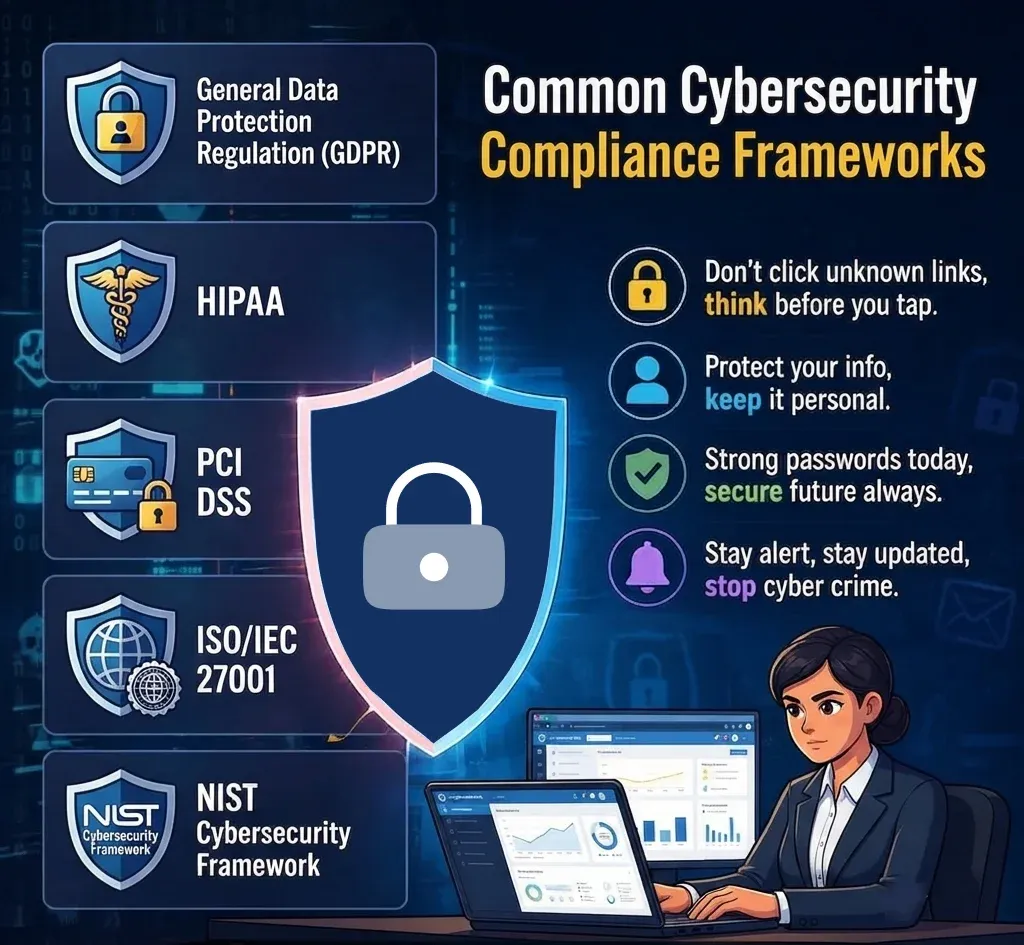
Common Cybersecurity Compliance Frameworks
Different industries follow different regulatory frameworks depending on their operational requirements, locations, and data-handling responsibilities.
General Data Protection Regulation (GDPR)
GDPR governs the collection, storage, processing, and protection of personal data belonging to individuals in the European Union.
Key requirements include:
- Data privacy controls
- User consent management
- Breach notification procedures
- Data minimization
- Privacy by design
HIPAA
Healthcare organizations and their business associates in the United States must comply with HIPAA to protect electronic protected health information (ePHI).
Requirements include:
- Access controls
- Audit logs
- Encryption
- Risk management
- Workforce security training
PCI DSS
Organizations that process, store, or transmit payment card information must comply with the Payment Card Industry Data Security Standard (PCI DSS).
It focuses on:
- Network security
- Cardholder data protection
- Vulnerability management
- Access control
- Continuous monitoring
ISO/IEC 27001
ISO/IEC 27001 is an internationally recognized standard for information security management.
It emphasizes:
- Information Security Management Systems (ISMS)
- Risk-based security controls
- Continuous improvement
- Security governance
NIST Cybersecurity Framework
Developed by the U.S. National Institute of Standards and Technology, the NIST Cybersecurity Framework guides for improving an organization’s cybersecurity practices.
Its five core functions include:
- Identify
- Protect
- Detect
- Respond
- Recover
Cybersecurity Compliance Requirements
Although requirements differ by industry, most cybersecurity regulations share several common security expectations.
Risk Assessment
Organizations must identify cybersecurity risks that affect systems, applications, networks, and sensitive information. Regular risk assessments help teams prioritize mitigation strategies.
Access Control
Businesses should restrict system access based on user roles and responsibilities. Access controls typically include:
- Multi-factor authentication (MFA)
- Least privilege access
- Identity management
- Role-based permissions
Data Protection
Sensitive information should be protected throughout its lifecycle. Security controls often include:
- Data encryption
- Secure backups
- Data classification
- Data loss prevention (DLP)
- Secure disposal procedures
Security Policies
Organizations need documented policies covering:
- Acceptable use
- Password management
- Incident response
- Remote work
- Vendor security
- Backup procedures
Continuous Monitoring
Compliance requires organizations to continuously monitor systems for suspicious activity, vulnerabilities, and unauthorized access attempts.
Monitoring may include:
- Security Information and Event Management (SIEM)
- Log monitoring
- Endpoint monitoring
- Threat intelligence
Incident Response Planning
Organizations should maintain documented procedures for responding to cybersecurity incidents. Incident response plans usually define:
- Detection
- Containment
- Investigation
- Recovery
- Reporting
- Lessons learned
Employee Security Training
Human error remains one of the leading causes of security incidents. Compliance programs typically require organizations to provide ongoing security awareness training that covers:
- Phishing
- Password hygiene
- Social engineering
- Safe browsing
- Data handling
Vulnerability Management
Businesses must regularly:
- Scan for vulnerabilities
- Patch operating systems
- Update software
- Perform penetration testing
- Eliminate known security weaknesses
Audit and Documentation
Compliance regulations require organizations to maintain documentation showing that security controls are operating effectively.
Documentation often includes:
- Audit reports
- Risk assessments
- Security policies
- Incident records
- Employee training logs
- Compliance reports
Cybersecurity Compliance Management
Cybersecurity compliance management is the ongoing process of maintaining, monitoring, and improving compliance across an organization. Effective compliance management brings people, processes, and technology together to reduce security risks.
Establish Governance
Organizations should define leadership responsibilities for cybersecurity compliance. This includes assigning security officers and compliance managers, as well as executive oversight.
Identify Applicable Regulations
- Every business should determine which laws and frameworks apply based on:
- Industry
- Geographic location
- Customer requirements
- Types of data handled
Perform Regular Risk Assessments
Compliance management begins with identifying:
Security gaps
Threats
Vulnerabilities
Business impacts
Risk assessments should then be updated regularly.
Implement Security Controls
Organizations should deploy administrative, technical, and physical safeguards aligned with regulatory requirements.
Examples include:
- Firewalls
- Endpoint protection
- Identity management
- Encryption
- Backup systems
- Network segmentation
Monitor Compliance Continuously
Continuous compliance monitoring helps detect configuration drift and policy violations before they become regulatory issues. Automated compliance monitoring tools provide real-time visibility into security posture.
Conduct Internal Audits
Periodic internal audits help organizations identify compliance gaps before external assessments occur.
Audits review:
- Security controls
- Documentation
- Policies
- Employee practices
- Technical configurations
Review and Improve
Cybersecurity compliance management is an ongoing cycle of:
- Assess
- Improve
- Monitor
- Audit
- Update
This continuous improvement approach helps organizations remain resilient against evolving cyber threats.
Cybersecurity Compliance Services
Many organizations partner with cybersecurity experts to simplify and strengthen their compliance efforts.
Professional cybersecurity compliance services often include:
Compliance Gap Assessments
Experts compare existing security controls against applicable regulations and identify areas that need improvement.
Risk Assessments
Consultants evaluate cyber risks and recommend mitigation strategies that support regulatory compliance.
Compliance Audits
Organizations receive independent assessments of their cybersecurity controls and documentation.
Policy Development
Compliance specialists create and update:
- Information security policies
- Acceptable use policies
- Incident response plans
- Business continuity procedures
Security Awareness Training
Training services educate employees on cybersecurity best practices while helping satisfy regulatory requirements.
Vulnerability Assessments and Penetration Testing
Security professionals identify exploitable weaknesses before attackers can exploit them.
Compliance Automation
Modern compliance platforms automate:
- Evidence collection
- Control monitoring
- Reporting
- Audit preparation
- Policy management
Automation can significantly reduce manual compliance workloads.
Managed Security Services
Many organizations outsource continuous monitoring, threat detection, and incident response to Managed Security Service Providers (MSSPs).
Best Practices for Maintaining Cybersecurity Compliance
Organizations can improve compliance outcomes by following proven best practices.
Conduct Regular Risk Assessments
Risk assessments are the foundation of an effective cybersecurity compliance program. Organizations should regularly identify and evaluate potential threats, vulnerabilities, and risks that could impact their systems, data, and business operations.
By understanding their risk landscape, businesses can prioritize security investments, address compliance gaps, and implement appropriate controls to reduce exposure. Regular assessments also help organizations adapt to evolving cyber threats and changing regulatory requirements.
Develop and Update Security Policies
Comprehensive security policies provide employees with clear guidelines for protecting organizational data and maintaining compliance. These policies should cover areas such as password management, acceptable use of company devices, data handling, remote work, incident response, and access control. Organizations should review and update these policies periodically to reflect new technologies, regulatory changes, and emerging cyber risks, ensuring they remain relevant and effective.
Implement Strong Access Controls
Restricting access to sensitive systems and information is a key compliance requirement across most cybersecurity frameworks. Organizations should adopt the principle of least privilege, granting employees access only to the resources necessary for their job responsibilities. Combining role-based access control (RBAC) with multi-factor authentication (MFA) significantly reduces the risk of unauthorized access and strengthens overall security while supporting regulatory compliance.
Continuously Monitor Systems and Networks
Continuous monitoring enables organizations to detect suspicious activities, policy violations, and potential security incidents in real time. Using tools such as Security Information and Event Management (SIEM), endpoint detection and response (EDR), and automated alerting systems helps security teams identify threats early and respond before they escalate. Ongoing monitoring also provides valuable audit logs and evidence needed to demonstrate compliance during regulatory assessments.
Keep Software and Systems Up to Date
Outdated software is a common target for cybercriminals because it often contains known vulnerabilities. Organizations should establish a structured patch management process to ensure operating systems, applications, firmware, and security tools are updated promptly. Regular updates not only improve security but also help meet compliance requirements that mandate timely vulnerability remediation and secure system maintenance.
Provide Ongoing Employee Security Awareness Training
Employees play a critical role in maintaining cybersecurity compliance. Regular training programs should educate staff on phishing attacks, social engineering tactics, password best practices, safe internet use, and the proper handling of sensitive information. Continuous awareness training helps reduce human error, strengthens the organization’s security culture, and ensures employees understand their responsibilities in supporting compliance efforts.
Perform Regular Security Audits and Compliance Reviews
Internal audits and compliance reviews help organizations evaluate whether their security controls remain effective and aligned with applicable regulations. These assessments identify compliance gaps, verify policy implementation, and ensure required documentation is complete and accurate. Conducting regular audits allows businesses to address issues proactively before external regulatory inspections or certification assessments.
Maintain Accurate Documentation
Proper documentation is essential for demonstrating compliance to auditors and regulatory authorities. Organizations should maintain detailed records of security policies, risk assessments, employee training, vulnerability scans, incident response activities, access control reviews, and audit findings. Well-organized documentation not only simplifies compliance reporting but also supports continuous improvement and accountability.
Strengthen Third-Party Risk Management
Many organizations rely on vendors, suppliers, and cloud service providers that may have access to sensitive data or critical systems. Businesses should assess third parties’ cybersecurity practices before establishing partnerships and monitor their ongoing compliance. Vendor risk assessments, contractual security requirements, and periodic reviews help ensure that external partners maintain security standards aligned with organizational compliance obligations.
Establish and Test an Incident Response Plan
A well-defined incident response plan enables organizations to respond quickly and effectively when cybersecurity incidents occur. The plan should outline procedures for detecting, containing, investigating, recovering from, and reporting security events. Regular tabletop exercises and simulated cyberattack scenarios help verify that the response plan works as intended and ensure employees understand their roles during an actual incident, supporting both operational resilience and regulatory compliance.
Conclusion
Cybersecurity compliance is an essential component of modern business operations. It helps organizations protect sensitive data, reduce cyber risk, and meet legal and industry obligations. By implementing strong security controls, conducting regular risk assessments, and embracing continuous compliance management, businesses can strengthen their cybersecurity posture while reducing the risk of costly penalties and reputational damage. Whether managed internally or through specialized cybersecurity compliance services, compliance is an ongoing commitment that supports long-term resilience, customer trust, and sustainable growth in an increasingly regulated digital world.
Frequently Asked Questions (FAQs)
Here are some of the most frequently asked questions.
Is cybersecurity compliance the same as cybersecurity?
No. Cybersecurity refers to the technologies, processes, and practices used to protect digital systems from cyber threats. Cybersecurity compliance focuses on meeting specific legal, regulatory, and industry security requirements. While cybersecurity improves protection, compliance helps organizations demonstrate that appropriate safeguards are in place in accordance with applicable standards.
Who needs to comply with cybersecurity regulations?
Any organization that collects, stores, processes, or transmits sensitive information needs to comply with cybersecurity regulations. This includes businesses in healthcare, finance, retail, government, manufacturing, education, technology, and many other industries. The applicable regulations depend on the organization’s location, industry, and the type of data it handles.
Is cybersecurity compliance a one-time task?
No. Cybersecurity compliance is an ongoing process. Organizations must continuously monitor security controls, conduct audits, update policies, assess risks, train employees, and adapt to evolving regulations and cyber threats.
How does a business achieve cybersecurity compliance?
A business can achieve cybersecurity compliance by identifying applicable regulations, performing risk assessments, implementing appropriate security controls, developing security policies, training employees, continuously monitoring systems, documenting compliance efforts, and conducting regular internal and external audits. Many organizations also work with cybersecurity compliance service providers to simplify the process and maintain ongoing compliance.
Table of Contents