That said, companies have to identify and fix their security gaps before attackers exploit them. In such a scenario, the role of penetration testing comes with great significance. It mimics the techniques used in real cyberattacks to reveal vulnerabilities, assess security posture, and improve defense systems, so that malicious activities have no chance of succeeding.
No matter how big an operation you are running, like a large multi-national corporation, or how small you are, like a startup company that is gaining momentum. Periodic penetration testing always yields new information about your computing infrastructure, software, and network. It enables organizations to address security gaps, meet regulatory compliance requirements, and protect sensitive data from evolving cyber threats.
According to IBM’s Cost of a Data Breach Report 2026, the average global cost of a data breach exceeded $4.8 million, highlighting the financial impact of inadequate cybersecurity measures. Additionally, Cybersecurity Ventures predicts that global cybercrime damages will reach $10.5 trillion annually, emphasizing why proactive security testing has become a necessity rather than an option.
What Is Penetration Testing?
Penetration testing, sometimes referred to as pen testing or ethical hacking, is a controlled cybersecurity evaluation that allows security experts to attempt to exploit weaknesses in a company’s IT infrastructure. While malicious hackers aim to breach systems for personal gain, a penetration tester legally tries out attack scenarios on a company’s internal or cloud computing systems.
Penetration testers do not intend to cause harm; their main goal is to identify vulnerabilities that potential attackers might exploit. These issues may include outdated software, weak passwords, poorly secured APIs, misconfigured servers, exposed databases, or vulnerabilities in web applications.
Penetration tests simulate the tactics and techniques of real attackers, making it easier for businesses to identify which security measures to strengthen. It becomes possible to prioritize security work and even prevent damage by remediation carried out before an actual incident.
How Does Penetration Testing Work?
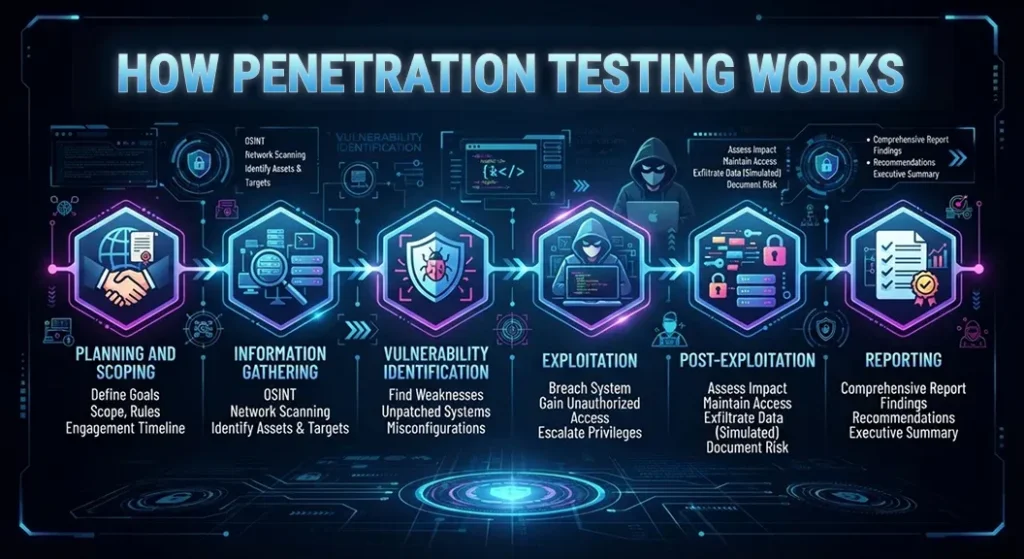
A penetration test typically follows a structured methodology to ensure comprehensive coverage.
Planning and Scoping
The first phase involves defining the objectives, identifying systems to be tested, establishing testing boundaries, and determining the rules of engagement. Organizations and security teams agree on the scope to ensure testing remains controlled and does not disrupt business operations.
Information Gathering
Penetration testers collect publicly available and internal information about the target environment. This reconnaissance phase identifies technologies, operating systems, exposed services, employee information, and potential attack vectors.
Vulnerability Identification
Using automated tools and manual techniques, testers identify weaknesses such as outdated software, insecure configurations, exposed services, weak authentication mechanisms, and coding flaws.
Exploitation
The tester attempts to exploit identified vulnerabilities using controlled attack techniques. Successful exploitation demonstrates the potential impact if a malicious attacker were to gain access.
Post-Exploitation
After gaining access, testers determine how far an attacker could move within the environment. This may involve privilege escalation, lateral movement, or accessing sensitive data while remaining within the approved testing scope.
Reporting
Finally, testers prepare a detailed report describing the vulnerabilities discovered, exploitation methods, risk levels, business impact, evidence, and recommended remediation steps.
Types of Penetration Testing
Organizations require different types of penetration testing depending on their infrastructure, applications, and security objectives.
Network Penetration Testing
Network penetration testing evaluates internal and external networks for vulnerabilities. Testers assess firewalls, routers, switches, servers, VPNs, wireless networks, and exposed services to identify weaknesses that could allow unauthorized access.
Web Application Penetration Testing
Modern businesses rely heavily on web applications, making them common targets for cybercriminals. Web application penetration testing identifies vulnerabilities such as SQL injection, Cross-Site Scripting (XSS), Cross-Site Request Forgery (CSRF), authentication flaws, insecure APIs, and session management issues.
Mobile Application Penetration Testing
This assessment focuses on Android and iOS applications, evaluating authentication, data storage, encryption, API communication, and insecure permissions.
Cloud Penetration Testing
Sending enterprises into a cloud environment has made cloud penetration a new thing, where security professionals are not only looking for bugs in the cloud but also at the cloud’s internal configuration as a whole. They will check things like identity management through access controls, which files are public, virtual private networks, cloud APIs, and cloud-optimized applications with unique security needs.
Wireless Penetration Testing
In testing wireless devices, we look for gaps in Wi-Fi setups, wireless endpoints, encryption methods, and unauthorized hardware, as well as the risk of unauthorized individuals or groups gaining access to systems through such methods.
Social Engineering Penetration Testing
Some cyber breaches don’t just depend on technology. Social engineering is a method of attacking a target by exploiting their social context and human weaknesses. Penetration testers conduct a human factors check by having employees click fake phishing links and play with their phone cameras to see if they get caught.
Physical Penetration Testing
The aim here is to determine whether unauthorized people could enter the office area where the server is kept or other areas where access is not authorized, through tailgating (piggybacking), lockpicking (key bypass), or copying a security badge (security badge cloning).
Penetration Testing for Small Business
Many business owners mistakenly believe that cybercriminals target only major companies. However, smaller organizations can be tempting targets, as they may lack strong security systems or sufficient resources.
Finding the Hidden Security Holes
Small businesses do not have large IT teams, so vulnerabilities may go unnoticed. A penetration test is an effective way to detect these weaknesses before an attacker discovers them.
Maintaining Customer Confidence
Consumers today take it for granted that their personal and financial data are protected by the businesses they deal with. Being the victim of a cyberattack can cause customers to lose faith and irreparably damage a brand.
Limiting Monetary Loss
Data leakage can cause a company to stop producing goods or services, incur penalties, settle legal disputes, or face government charges. It also involves the cost of repairing the damage. Ongoing Pen Tests can reduce all these risks by strengthening the company’s security from the outset.
Facilitating Business Expansion
A company’s digital system becomes more complicated the more it grows. Security audits from time to time are necessary to ensure that the development does not introduce vulnerabilities.
Boosting Ability to Handle Emergencies
Pen Testing provides companies with insights into how attackers work. It enables IT staff to design better plans for intrusion detection, response, and recovery.
An Assurance of Compliance
Several rules and cybersecurity guidelines recommend, or even require, that businesses have security controls verified by Penetration Testing from time to time to ensure that confidential information is protected.
Benefits of Penetration Testing
The following are the benefits of penetration testing.
Discovers Real Exploitable Vulnerabilities
Unlike automated scanners, penetration testing validates whether vulnerabilities can actually be exploited, helping organizations focus on genuine risks.
Evaluates Security Controls
Testing measures the effectiveness of firewalls, intrusion detection systems, endpoint security, authentication mechanisms, and access controls.
Prioritizes Security Investments
Organizations receive risk-based recommendations, allowing them to allocate cybersecurity budgets more effectively.
Reduces Business Risk
Fixing vulnerabilities before attackers discover them significantly lowers the likelihood of successful cyberattacks.
Enhances Security Awareness
Penetration testing often highlights employee-related security weaknesses, supporting stronger cybersecurity training initiatives.
Supports Regulatory Compliance
Regular testing demonstrates due diligence and helps organizations satisfy industry standards such as PCI DSS, ISO 27001, HIPAA, SOC 2, and other cybersecurity frameworks.
Best Practices for Effective Penetration Testing
The following are the best practices for effective penetration testing.
Define Clear Testing Objectives and Scope
A successful penetration test begins with clearly defined objectives and a well-established scope. Organizations should identify which systems, applications, networks, cloud environments, or APIs will be tested and determine the assessment’s goals. Setting clear boundaries ensures the testing process remains focused, minimizes disruptions to business operations, and yields meaningful results aligned with the organization’s security priorities.
Conduct Regular Penetration Tests
Penetration testing should not be treated as a one-time activity. Cyber threats evolve continuously, and new vulnerabilities emerge as businesses update software, deploy new infrastructure, or adopt cloud services. Organizations should perform penetration testing at least annually, after major system changes, or following significant software releases to ensure their security posture remains strong against emerging threats.
Combine Automated Tools with Manual Testing
Automated vulnerability scanners are valuable for quickly identifying known security issues, but they cannot detect every weakness. Manual testing performed by experienced security professionals uncovers complex vulnerabilities, business logic flaws, and sophisticated attack paths that automated tools may overlook. Combining both approaches provides a more comprehensive assessment of an organization’s security.
Simulate Real-World Attack Scenarios
Effective penetration testing should replicate the tactics, techniques, and procedures used by real cybercriminals. Testing realistic attack scenarios helps organizations understand how attackers could gain access, move laterally across systems, escalate privileges, or access sensitive data. This approach provides practical insights into security weaknesses and the potential impact of a successful cyberattack.
Prioritize Critical Vulnerabilities
Not every discovered vulnerability presents the same level of risk. Organizations should prioritize remediation based on factors such as exploitability, business impact, data sensitivity, and the likelihood of an attack. Addressing high-risk vulnerabilities first helps reduce the organization’s exposure to serious cyber threats while ensuring resources are allocated effectively.
Perform Retesting After Remediation
Fixing vulnerabilities is only part of the security process. After remediation efforts are complete, organizations should conduct follow-up penetration testing to verify that security issues have been successfully resolved and that no new vulnerabilities have been introduced during remediation. Retesting confirms the effectiveness of implemented security measures.
Include Internal and External Testing
Comprehensive penetration testing should evaluate both external-facing assets and internal systems. External testing assesses internet-facing applications, websites, and networks that attackers can access remotely. In contrast, internal testing examines potential threats originating from compromised accounts, insider attacks, or attackers who have already gained initial access. Testing both environments provides a complete picture of organizational security.
Test Cloud and Remote Work Environments
With businesses increasingly relying on cloud platforms and remote work, penetration testing should include cloud infrastructure, remote access solutions, virtual private networks (VPNs), collaboration platforms, and identity management systems. These environments often introduce unique security risks that require specialized testing techniques to identify configuration errors and access control weaknesses.
Conclusion
Penetration testing has become an essential component of modern cybersecurity. By simulating real-world attacks, organizations gain valuable insight into their security posture and identify vulnerabilities before cybercriminals can exploit them. Whether protecting enterprise networks, cloud environments, web applications, or mobile platforms, penetration testing helps reduce cyber risk, strengthen defenses, and improve overall resilience.
For small businesses, regular penetration testing is particularly valuable because it uncovers hidden weaknesses, protects customer data, supports compliance efforts, and builds confidence in the organization’s security. Combined with continuous monitoring, employee awareness, and vulnerability management, penetration testing enables businesses to stay ahead of evolving cyber threats.
Frequently Asked Questions
Here are some of the most common frequently asked questions.
How is penetration testing different from a vulnerability scan?
A vulnerability scan uses automated tools to identify known security weaknesses across systems and applications. Penetration testing goes further by allowing ethical hackers to exploit vulnerabilities manually, determine whether they are truly exploitable, and assess their potential business impact. While vulnerability scans identify possible issues, penetration testing validates real-world attack scenarios.
What does a penetration test report include?
A penetration test report typically includes an executive summary, testing scope, methodology, discovered vulnerabilities, severity ratings, evidence of successful exploitation, business impact, risk prioritization, screenshots where applicable, and detailed remediation recommendations. Many reports also provide compliance mapping and an overall assessment of the organization’s security posture.
What can penetration testing uncover?
Penetration testing can uncover insecure configurations, outdated software, weak authentication mechanisms, exposed services, privilege escalation paths, web application vulnerabilities, cloud security misconfigurations, insecure APIs, poor access controls, and business logic flaws that automated scanners may overlook.
Why is penetration testing important?
Penetration testing is important because it helps organizations identify and remediate exploitable vulnerabilities before attackers can use them. It reduces the risk of data breaches, strengthens overall security, improves incident preparedness, protects customer trust, and supports compliance with industry regulations.
Why is penetration testing better than a vulnerability scan alone?
A vulnerability scan provides a list of potential security issues, but cannot determine whether those issues can actually be exploited. Penetration testing combines automated scanning with manual validation, demonstrating how attackers could chain vulnerabilities together to compromise systems. This provides a more realistic assessment of an organization’s security posture.
Why do small businesses need penetration testing?
Cybercriminals increasingly target small businesses because they often have fewer security resources and less mature defenses. Penetration testing helps identify hidden vulnerabilities, improve security controls, protect sensitive customer information, reduce the likelihood of costly breaches, and support long-term business resilience.
Why does penetration testing help with compliance?
Many cybersecurity regulations and standards, including PCI DSS, HIPAA, SOC 2, ISO 27001, and others, recommend or require periodic penetration testing to verify the effectiveness of security controls. Regular testing demonstrates proactive risk management, supports audit readiness, and helps organizations maintain compliance with industry requirements.
Table of Contents